

So, here we are: Will Buckingham’s Wayward Things has been reincarnated, and has found a new home on Substack. This newsletter has gone through various incarnations over the years, but I’m excited by the latest move. It’s a chance to head out on a new journey, in a slightly different direction.
Wayward Things is a free newsletter about philosophy, literature, culture, art, history, religion, and the big, bewildering business of human existence.
If you are receiving this newsletter, it is because once upon a time, perhaps in the dim and distant past, you signed up—either on my website willbuckingham.com, or via my earlier project Looking for Wisdom. If you want to continue receiving the newsletter, you don’t need to do anything special; but if you don’t, then just scroll down to the bottom and you can unsubscribe.
Taking Thoughts for A Walk
As this is a new start of sorts, I thought I’d say a bit about what I’m planning. I’ll be posting twice a month, (except during holiday periods). And most of what I’ll be doing is taking thoughts for a walk.
I’ve stolen this idea from a quote often attributed to the wonderful Swiss artist Paul Klee. I have loved Klee’s work since I was an art student in Northern England back in the 1990s. The quote, which you can find all over the internet, is this: ‘a drawing is a line going for a walk.’ While the quote is not entirely accurate, it certainly feels like something that Klee might have said. The closest source I can find is the first volume of Klee’s notebooks, The Thinking Eye, where the artist circles repeatedly around the connection between drawing and walking, describing a line that ‘goes out for a walk, so to speak, aimlessly for the sake of the walk.’1
So here, for the sheer fun of it, are some of Paul Klee’s lines, going for an aimless stroll.
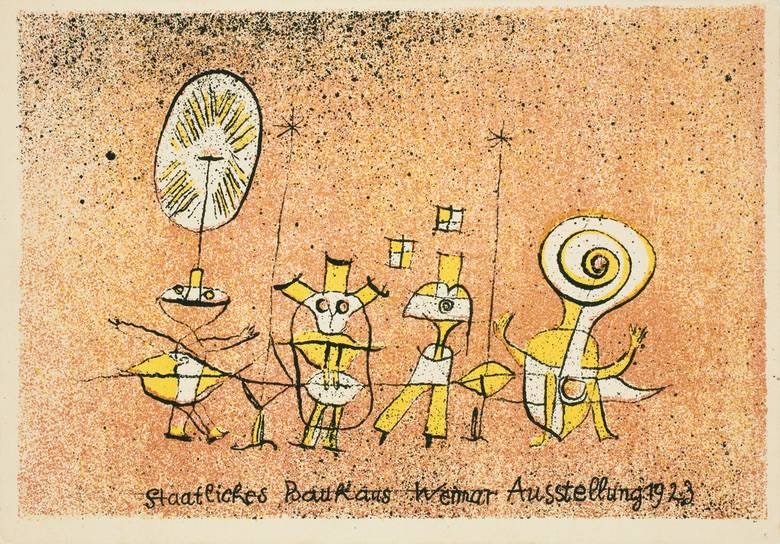

I’ve stolen this idea here because I think that taking a thought for a walk seems like a good way of capturing something of my own approach to philosophy. There are lots of ways of imagining what philosophy is: rigorous critique, the clarification of concepts, a way of grappling with life’s fundamental questions, a grandiose quest to know the mind of God, or what have you. But for me, the kind of philosophy I like is the kind that takes thoughts for a walk, to see where it ends up.
In making use of this idea of taking a thought for a walk, I can’t claim any great originality. It’s an idea I’ve come across several times before. It was, for example, something the poet Andrew Motion talked about in an address at Manchester Cathedral in 2011. However, original or not, the idea of taking a thought for a walk not only captures well my own approach to philosophy, but it also taps into a longstanding connection between philosophy and walking. And it is a vision of philosophy that is fundamentally open-ended. When you take a thought for a walk, you never know quite where you are going, or what you will stumble upon. Going for a walk is not the same as walking somewhere. It is creativity, not transport. One of the philosophers I love, Michel Serres, writes in his book The Troubadour of Knowledge that philosophy is a kind of discovery, a process of finding. ‘Meaning,’ Serres insists, ‘is gained in walking.’2
And as you walk, this process of discovery happens in dialogue with the thoughts you bring along with you. Some of these may be admirably well-behaved and go wherever you lead them. Others are harder to manage, like big, unruly dogs—you leave the house thinking that you are taking them for a walk, but before too long, you realise it’s they who are taking you for a walk. As a result, you end up chasing them all over the place, finding yourself dragged here and there, and getting into all kinds of scrapes. And then there are those thoughts that, on the surface, look harmless and tame, trotting along beside you and lulling you into a false sense of security, but when you get them to the park and let them off the leash, they run riot, chasing the squirrels and causing havoc.
What all this means is that when taking thoughts for a walk, you never know what will happen, what you are going to find along the way, or where you are going to find yourself. And while this whole business can be sometimes perilous, it can also make the world much more interesting.
A Menagerie of Thoughts
All this is a way of saying that I have no clear destination for this newsletter: the business of taking thoughts for a walk is too unpredictable for that. But what I can share—here in my first post on this new platform—is a glimpse into the diverse menagerie of thoughts waiting patiently to be taken for a stroll. Here are some of them:
Why, despite what we’re told, life really isn’t short (spoiler: it’s not long, either).
How the obsession with talking to strangers (and advice about how we can get better at talking to strangers), is missing the point.
What the revival of traditional weaving in Maluku, East Indonesia says about how stories, philosophies, and traditions are woven and re-woven.
Why divination is unreasonable—but why sometimes being unreasonable is the most reasonable choice.
Park-keepers, bureaucrats and the apocalypse: what the Moomins have to teach us about life’s greatest perils.
How an offer to bake scones for a friend led to my accidentally joining a cult.
Why there is no such thing as the “human condition”.
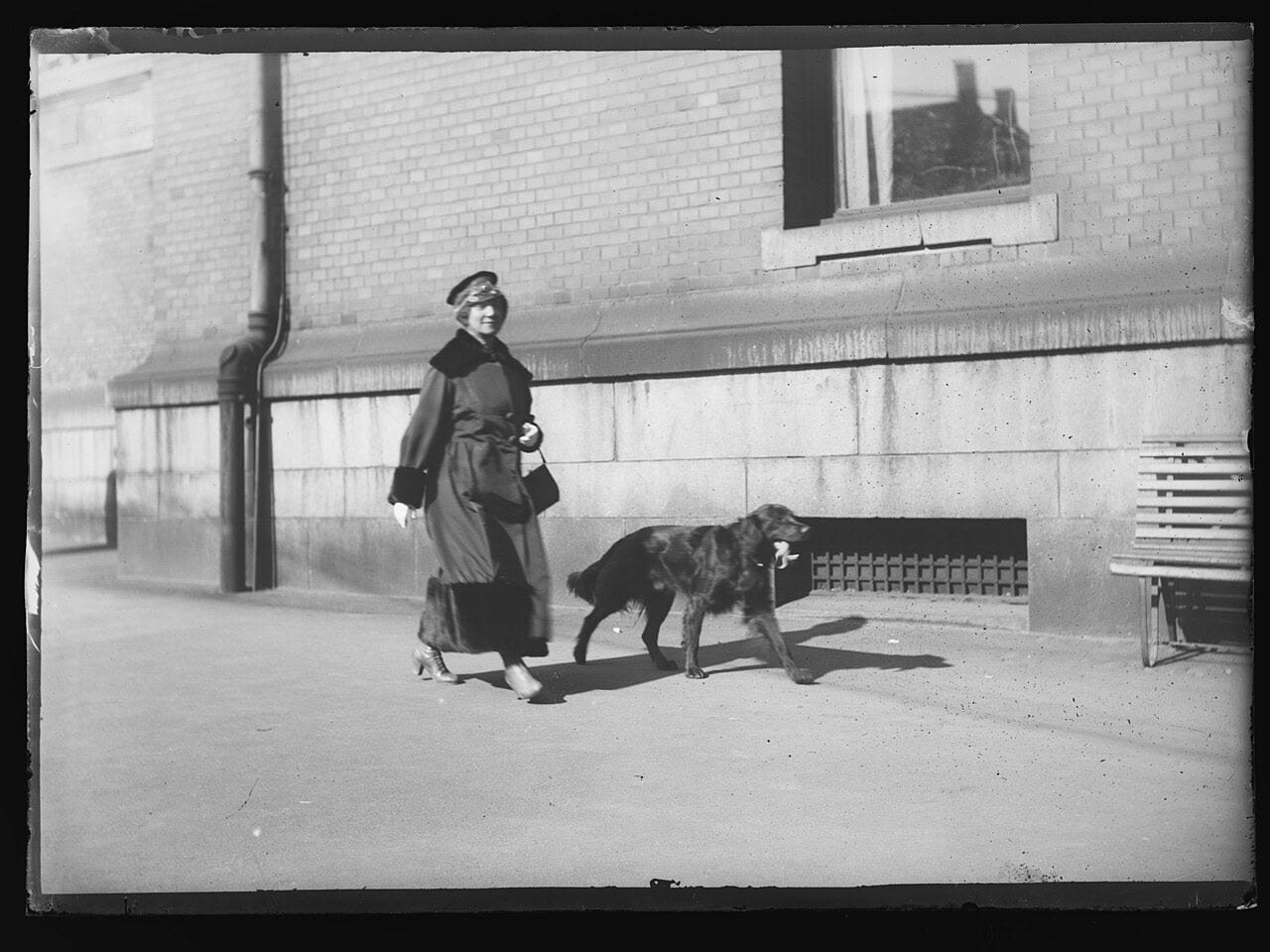

In the mix with all this will be bits and pieces about projects I’m working on, snippets of music, art, books, poems, translations… Because one of the things about taking thoughts for a walk is that, along the way, you pick up all kinds of detritus—all kinds of small treasures—to fill your pockets.
As for where this will all lead… As yet, there’s no way of telling. The Zhuangzi puts it best: 道行之而成. It is through walking that the path becomes a path. So who knows what new paths will open up? But I hope you join me on these small adventures, and if you know anybody who might like this newsletter, and who wants to come along for the ride, please share it with them as well.
All the best, and I’ll see you in a couple of weeks,
Will
Klee, Paul, Notebooks Vol. 1: The Thinking Eye (Lund Humphries)
Serres, Michel, The Troubadour of Knowledge (The University of Michigan Press, 1997).
Appreciate iterative innovation!